

New Delhi / Bengaluru / Mangaluru: An unprecedented incident inside the Supreme Court of India, where a lawyer attempted to throw a shoe at Chief Justice of India (CJI) B.R. Gavai, has triggered widespread outrage and protests across the country. Legal bodies, civil society groups, and political leaders have condemned the act, describing it as an assault on the dignity of the judiciary and the democratic fabric of the nation. Meanwhile, disciplinary and criminal proceedings have been initiated against the accused advocate, identified as Rakesh Kishore.
The incident occurred during a court session on October 6, when Rakesh Kishore allegedly took off his shoe and tried to hurl it toward the CJI while court proceedings were underway. Security personnel immediately intervened and overpowered him before any harm was done. The Supreme Court Bar Association (SCBA) and the Bar Council of India (BCI) swiftly took action, with the BCI suspending Kishore’s license to practice law, calling his act “inconsistent with the dignity of the profession.” The SCBA also revoked his membership and condemned his behaviour as “gross misconduct.”
Following the incident, the Supreme Court expressed deep concern over the attack. Chief Justice Gavai later said he was “very shocked” by the incident but described it as a “forgotten chapter,” emphasizing the importance of moving on without compromising institutional dignity. Justice Vinod Chandran, who was on the bench with the CJI, termed the attempt “not a joke” but an “affront to the institution.”
Advocate Kishore, however, remained unrepentant after being detained. Speaking to the media, he claimed his action was not out of anger but a form of protest over what he called “judicial interference in Hindu religious matters.” He alleged that remarks by the CJI in a recent temple restoration case had hurt his religious sentiments. “This act was not out of rage but an expression of pain,” he said, adding that he did not regret his conduct. He also claimed he was “guided by divine instruction” to act as he did.
Police action has already begun in connection with the case. In Bengaluru, the first FIR against Kishore was registered at the Vidhana Soudha Police Station under Sections 132 and 133 of the Indian Penal Code, based on a complaint filed by advocate Bhakt Vusal. Since the incident took place in New Delhi, the case has been recorded as a ‘zero FIR’ and will be transferred to the concerned police station in Delhi. Reports suggest that the Attorney General has been requested to grant permission for a contempt and criminal investigation.
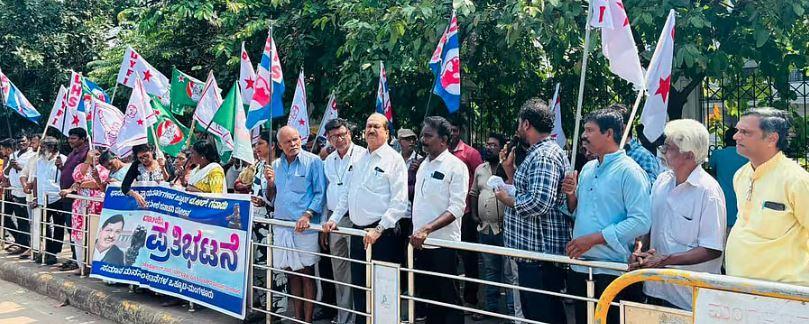
The incident has provoked strong reactions and protests across Karnataka. In Mangaluru, several organisations, including lawyers’ associations, farmers’ and workers’ unions, and social groups, held a joint protest near the Clock Tower, condemning the act and calling it part of a larger extremist mindset. District Bar Association President Yashwant Muruli said that the act was not an isolated outburst but reflected an organized ideology linked to right-wing forces. Dalit leader M. Devadas, AITUC leader B. Shekhar, social activist Vasudev Uchila, and others denounced the attempt as an attack on the country’s democratic system and judicial independence.
In Udupi, the local Bar Association convened an emergency meeting and passed a resolution condemning the act as a direct attack on judicial dignity. The association demanded strict punishment for the accused to uphold the sanctity of the courts. Dalit Sangharsh Samiti and allied organisations announced that they would hold a protest on Friday evening near the War Memorial in Udupi, demanding that a case be filed against Kishore under the Unlawful Activities (Prevention) Act (UAPA).
Protests have also been reported in Bengaluru, where lawyers and progressive activists gathered outside the High Court, demanding that stringent charges, including UAPA, be invoked against Kishore. Senior advocate S. Balan called the act “a criminal assault on democracy and the judiciary,” adding that such extremist behaviour undermines the very foundation of India’s legal system. The Mysuru Bar Association also boycotted court proceedings and demanded immediate legal action.
Nationally, leaders from across the political spectrum have expressed concern. Prime Minister Narendra Modi reportedly spoke to Chief Justice Gavai over the phone and condemned the act as “reprehensible.” Former IPS officer and BJP leader Bhaskar Rao, who initially praised Rakesh Kishore’s “courage” on social media, later apologised after facing widespread criticism. Rao clarified that he had no intention to hurt the judiciary or any community, saying, “If my words have caused pain, I sincerely apologise.”
Meanwhile, AIMIM chief Asaduddin Owaisi questioned whether law enforcement would have acted with equal restraint had the accused belonged to another community. “If his name was not Rakesh but Asad, what would the Delhi Police have done?” Owaisi asked in a social media post.
Legal experts and retired judges have also weighed in on the controversy. Former Supreme Court Justice Markandey Katju described the incident as “highly condemnable,” though he suggested that judges should be cautious about making remarks that could be perceived as provocative in sensitive religious matters.
Across the nation, the shoe-throwing incident has reignited debates on judicial decorum, religious sensitivities, and the limits of free expression within the courtroom. It has also raised concerns about courtroom security, with calls for enhanced measures to prevent similar breaches in the future. Many see the act as a grim reminder of how religious polarization and intolerance can spill into the country’s most sacred institutions.
The case against Rakesh Kishore is expected to be transferred to Delhi Police for further investigation. The Bar Council’s disciplinary proceedings are underway, and contempt of court charges are likely to follow. Observers say that how the judiciary and law enforcement handle this matter will serve as a crucial test of India’s commitment to protecting judicial dignity while upholding the rule of law.